What’s in a name? (Quite a lot)

I’m doing some organisational values and culture comms at the moment, and one of the aspects to this is a piece on respect for names, name changes and name pronunciation, and how we can all easily take the time to make sure we say our colleagues’ names correctly. 

It’s got me thinking about a conversation with a senior editor in my first journalism job, at a community newspaper. This senior editor’s advice – always make sure you get people’s names right – has been important all through my career. I can still remember her words: “People get upset when their names are spelled incorrectly. Even if you get everything else right in a complex article, spell their name incorrectly and you’ll hear about it from them in letters, phone calls and emails.”

I, too, get annoyed when people get my name wrong. My surname – short but deadly – has tripped many people up. (It’s pronounced “pole”, as in North Pole, by the way.) It drives me nuts when someone calls me Joanna, instead of Joanne. It’s not so much a pronunciation issue as it is about accuracy, with my first name, but no less agitating. 

I am touched when people I meet for the first time ask if I prefer “Jo” or “Joanne” (thank you for asking!). My response is usually, I don’t mind either “Joanne” or “Jo”, but please, never “Joanna”. You may as well call me “Gertrude” because it’s no more my name than “Joanna” is. I have since found that many Joannas I meet experience the reverse, being called Joanne – much to their equal frustration. 

The new LinkedIn functionality to record the pronunciation of your name is so timely, and I’ve recorded mine. I think it’s great that we now have the opportunity to help others in pronouncing our names.

Our names – spelling, pronunciation, or changes to our names – are deeply personal to us. They connect to family traditions, our cultures and histories. They are the words we use to define and identify our ‘self’. Let’s all take the time and make a little effort in showing each other the respect and courtesy of getting each others’ names right.

Multi-skilled Administrators and Executive Assistants make great IC Practitioners

Far from being outliers in the talent pool of potential new hires, executive assistants’ skills could be a huge contribution to an IC team.

First published 30 November 2018 on Voice Online:

https://voice.ioic.org.uk/item/705-why-administrators-and-executive-assistants-make-great-ic-practitioners

I worked in admin before I made my career move into comms, and for many years worried that my time in support roles would disadvantage me. It felt like my would-be internal communications peers were racing ahead, getting a competitive edge with their experience of writing content, managing campaigns and relationships, and learning to become confident stakeholder managers.

By contrast, it felt like my time as an executive assistant (EA) wouldn’t add much to my offering as an IC practitioner.

As it turns out, I was totally wrong. I made my way into comms from admin (via a sideways move in investor relations and marketing) and came to see first-hand how my experience at the executive support coalface, far from holding me back, helped me hit the ground running in internal communications.

Conversations with fellow IC practitioners have borne the same conclusion: people with executive support and administration backgrounds aren’t disadvantaged by these previous roles. If anything, this experience has equipped them with a unique skillset which makes them great IC practitioners.

The skills that set you up for a rewarding IC career

Leah Bowden, head of internal communications at Close Brothers, spent some of her early career working as an EA and Senior EA to the Chief Executive at Santander, and believes that the experience has helped her IC career.

“Being an EA is one of the most intense forms of business partnership. The skills I developed in creative problem-solving, negotiating, influencing and prioritising effectively have served me well as an IC practitioner,” she says.

After moving into corporate communications and speechwriting at the bank, Leah became a key communications liaison and counsel for leaders and board-level executives – so she needed to be able to deal with very senior individuals, which her EA experience prepared her for.

“I believe being an EA is a great proving ground for the resilience you need for a rewarding career in IC,” she adds.

Lizzie Forbes, project communications manager at Balfour Beatty plc, has experienced this first-hand.

“Often personal assistants are advocates for the business; the ones in the know, much like IC practitioners, and are equipped or expected to share messages around the business.

“They are respected among their peers, have great networks and are trusted; all qualities of a great internal communicator! It was a natural transition for me as these were things I loved about my job, as well as writing,” she says.

Graham Barton heads up change enablement at Defra and was named best internal communications manager at IoIC’s 2017 Icon Awards.

Early on in his career he worked within office administration. “The role was at the Environment Agency, and I supported the leadership team and helped run the office,” he says.

Aside from teaching him how to communicate with a diverse group of colleagues, many of whom were based in the field, he says the role helped him learn how to package messages effectively.

“Striking that balance between including enough information to enable the recipient to make an informed decision, and keeping the communication as concise and clear as possible, was a very valuable skill to learn,” he says.

Transferable experiences

Backgrounds in administrative and executive support should make for sought-after candidates for internal communication managers looking to add to their teams, thanks to the wealth and depth of experience they can bring to the profession.

How exactly, then, are the experiences of former EAs, PAs and administrators so helpful for working within IC, and why should hiring managers care?

I’m confident the transferable skills and experiences gained by EAs and administrators can be found in all six areas of IoIC’s internal communications profession map. But for now, I’ll focus on three of these areas: organisational strategy and planning, people and cultural understanding, and coaching and facilitating.

Organisational strategy and planning

EAs understand the importance of a company’s strategy

While EAs may not be involved in actively shaping an organisation’s strategy, they will often be working close to its development, evolution, implementation and – of course – how it is communicated. Working with directors and/or C-suite executives grants EAs an unusual degree of insight into the importance of a strong strategy. EAs will need little convincing of the pivotal role played by a company’s strategy in driving its actions and direction.

In my own experience as an executive assistant, I was plunged headfirst into the detail of how strategy was formulated, how it evolved, and how it was communicated from the MD to his direct reports and the wider company. The strategy was fundamental to everything: it underpinned our direction and gave guidance for challenging business decisions.

More than almost any other employee, EAs and PAs will have an appreciation for the strategy as a guiding light for the company.

EAs get to grips with a company’s structure and place in the market

Working as an EA, you are required to quickly grasp your organisation’s structure, and its place in the wider market. You need to know how the company works, in order to do your day-to-day job effectively, but also learn what kind of links and levers you can utilise to get projects, communications and activities signed off.

Georgina Carvell-Gough manages the UK and Ireland internal communications strategy for Baxi Heating, and formerly worked in internal communications at Aldi UK. She was a PA for five years and found that it gave her a greater understanding of how businesses work.

“PAs, EAs and administrators will have an in-depth knowledge of how a business works and an appreciation for how each layer of a business views a message differently,” says Georgina. “They also need to have a good understanding of how each level within a business works, and also have to be comfortable in engaging with stakeholders from each level.”

Of course, every company is different, and being an EA in one organisation doesn’t mean you’ll necessarily understand how all companies operate. But you will most likely have learned what sorts of conversations to have, and which functions you need to go to, to find out what you need to know.

Planning (usually) comes naturally

Finally, a good EA or administrator is good at planning. Their role requires ninja-level organisation, and so an EA worth their salt will have developed – and implemented – complex plans.

Even if these plans have been for detailed travel itineraries, high-profile site visits or an investor roadshow, the content of the planning isn’t what’s important: it’s the ability to plan ahead, set milestones and buffers for delays, and adapt the plan to changes, that are essential skills.

Carly Murray, internal communications specialist at design, digital and IC agency The Surgery started her career as a PA. After her beginnings in executive support, Carly went on to communications roles at T-Mobile and EE and internal communications business partner roles at EasyJet and British Gas.

“So many things in the world of the PA translate well into IC,” she states. “PAs tend to be naturally good at planning and organising: you’re not just organising yourself, but you’re making sure other people, in other parts of the business, are organised too. IC is often about having a well-thought-through plan and using your organisation skills to execute it.”

People and cultural understanding

EAs are good with people – at all levels of the organisation

Apart from a strong organisational understanding, an ability to plan and be meticulously organised, an EA needs to be good with people. This means being able to communicate confidently with colleagues at all levels – be it the leadership team, middle managers or junior employees.

It came as a surprise to me, having moved from executive support to communications, that some of my communications colleagues (not from an admin support background) were nervous at the prospect of having a discussion with, or sending an email to, senior leaders.

I’ve since realised that having the confidence to approach someone senior like the CEO to discuss an important communications matter or send an email to the senior leadership team doesn’t come naturally to everyone, least of all those unaccustomed to interacting with them.

Past experience of dealing with senior-level executives helps to build that confidence, because, as an EA, emailing the CEO is usually not an exception, but rather the rule.

They understand the ‘gulf’ between leaders and employee

“The ‘gulf’ between what employees think and what senior leaders think employees think is something you become acutely aware of when working in admin or executive support,” says Annique Simpson, internal communications manager at Close Brothers.

Before her roles in communications, which saw her deliver internal campaigns at Grant Thornton UK LLP and Moorfields Eye Hospital, Annique worked in administrative roles at the London Deanery and the Royal College of Anaesthetists.

Communicators who have had first-hand experience of seeing how senior leaders interpret employees’ beliefs have a powerful advantage.

“Being able to spot the ‘gulf’ – and provide helpful, evidence-based solutions to help bridge it – is critical to being an effective internal communicator,” she says.

Good EAs have an ability to read company culture, and have an appreciation of the vision and value

EAs need to be adept at building an understanding of their company’s culture. By knowing what behaviour is accepted and which values are shared, they can make sure their way of working gels with the company’s culture. A good EA will not only work to a company’s culture, paving the way to effectiveness and success, but will also understand the importance of demonstrating the company culture in their behaviour and ways of working, due to the highly visible nature of their role.

Similar to this ability to ‘read’ a company’s culture and adapt to it, is appreciating and quickly building an understanding of an organisation’s vision and values. As with the strategy, an EA may likely find themselves close to the activity of formulating the vision and values, and will have an appreciation of their importance.

Coaching and facilitating

They learn how to develop and maintain internal networks

Executive support and administrative employees rely heavily on their internal relationships to do their roles effectively. I recall spending time creating and maintaining relationships with colleagues around the world when I was an EA, in order to grease the wheels for future work to be done with them.

Building and managing relationships and networks, and having the ability to influence and negotiate with colleagues, are yet more core skills and knowledge areas that EAs bring to an IC role.

Lisa Hattersley, internal communications manager at Charles Stanley, finds that her ability to build a network has reaped big rewards in her IC career. She first honed this skill at the start of her working life, as an EA at a documentary film company.

“Working as an EA or office manager is, by its nature, a very sociable role,” reflects Lisa. “You spend your whole time building relationships with people, and you become someone people turn to do ‘get things done’, because they know that you will know someone, who will know someone, who can help.

“Exactly the same skills are needed in IC. You need a wide-reaching network you can trust to make sure your messages land effectively.”

EAs know how to negotiate and ask for things

As a PA, you’re a naturally well-connected person in the company, says The Surgery’s Carly Murray.

“You’re usually asking people for things, so you need to be good at ‘selling’ your request and negotiating. And you’re bound to have the knack of seeing things from different perspectives, as you’re always trying to keep lots of people happy at the same time.”

An understanding of how busy leaders and executives are, and how you can make their lives easier, can help you get things done, as Lucy Kemp discovered.

Lucy is an employee communications and engagement consultant at K & Co Communications Ltd, and worked as an EA for around five years prior to moving into communications.

“In internal communications, we ask executives and leadership teams to get involved with events, write articles and give speeches when they might not have the time to understand the impact. Making it easy for them to do these things – building a good relationship with their PA/EA helps a lot – and also showing them the impact afterwards can lead to them saying ‘yes’ to things in the future,” says Lucy.

Good EAs usually have great EQ

Working with senior stakeholders requires an ability to understand things from their point of view, and this EQ – emotional quotient, or emotional intelligence – can be gained by people in admin and support roles, adds Annique.

“To be an effective administrator or EA, you need a high EQ. After all, if you can’t understand the challenges that your colleagues are up against, how can you give them the support they need? It’s no different working in IC – senior leaders trust you to understand their corporate environment and advise them accordingly. Having a high EQ can go far in terms of getting them onside and getting the job done.”

Not just outliers in the talent pool

People with backgrounds in admin and support should not be viewed as having “only” been a PA. This view risks overlooking fundamental skills and experience that not only make them great internal communications practitioners, but can add real value to internal communications teams.

I spent too long labouring under the misconception that my comms career would be stunted by the years I spent working as an EA and office administrator. In fact, this experience has hugely helped, not hindered, my career – and I’m really pleased that many hiring managers are seeing this potential.

We need to stop living through our mobile phones

I went to the Picasso 1932 exhibition at the Tate Modern yesterday: an astounding compilation of works by the giant of modern art, from a particularly prolific time in his career. I was blown away by the art, and the fact that I had the opportunity to see the original works in the flesh.

Like so many Londoners, I am originally from somewhere else, and I am keenly aware that living in this city has afforded me opportunities to see, hear and experience so much more than I otherwise would have. From an exhibition of original Leonardo da Vinci drawings and a massive retrospective of Matisse’s cutouts, to performances of Elgar in the Royal Albert Hall and a live concert by Alanis Morisette at the Eventim Apollo, over the years I’ve been lucky to enjoy a formidable array of arts and cultural experiences.

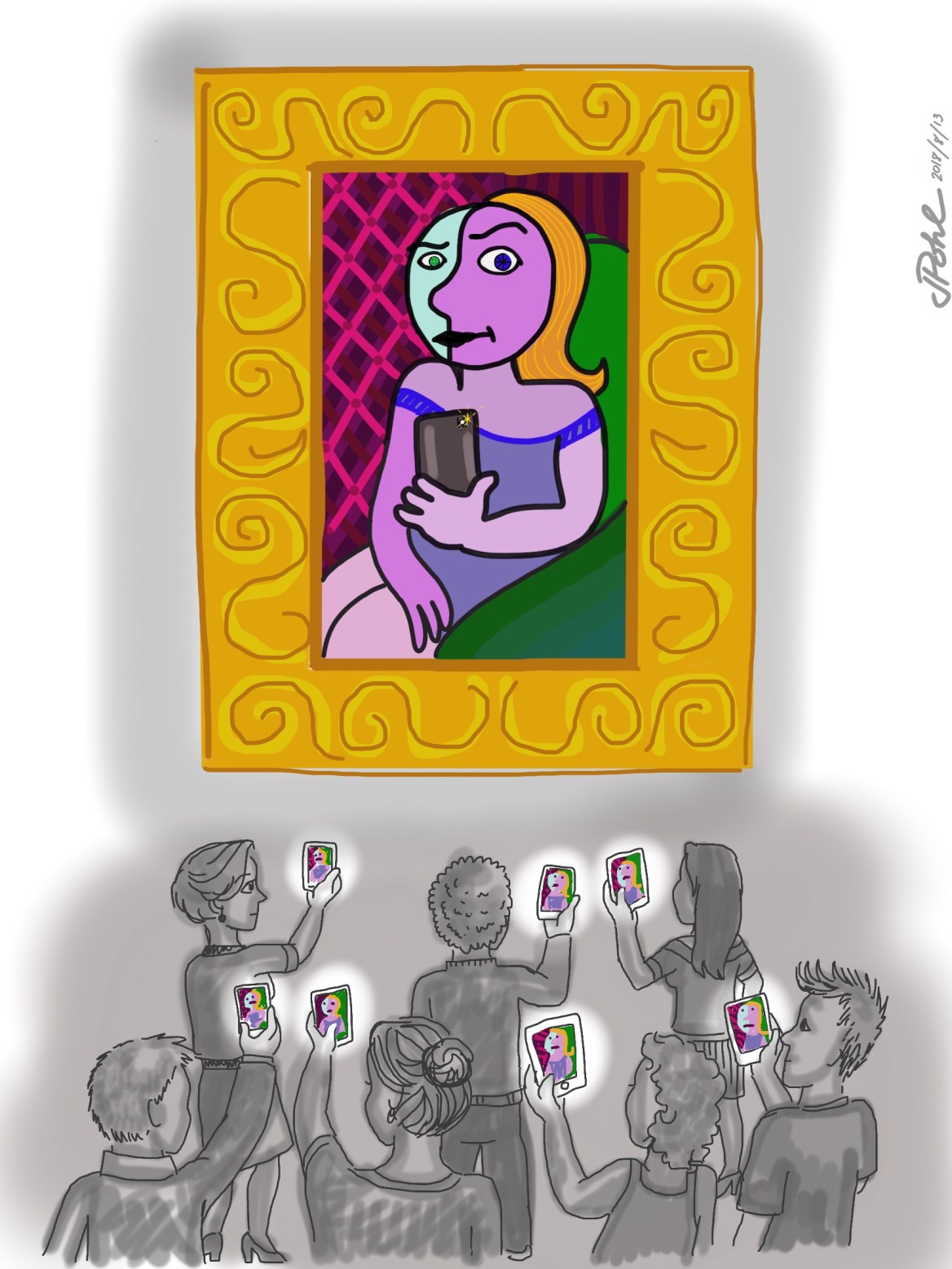
Living through our mobile phones.jpgThe richness and variety hasn’t waned over the years, but what I have seen is the rise and rise of people experiencing these joys through their mobile phones: recording live events and photographing artwork.

At one point, as I made my way through the Picasso exhibition, there were more people snapping pics of the artworks and labels, than those not. What’s more, it seemed that most were stopping long enough just to take a photo, and moving on to the next artwork, without lingering to give the paintings much consideration.

Of course, I don’t believe it’s my place to dictate how people choose to engage with art (some might like to give each painting a lot of thought; others prefer to have a more fluid walk-through of an exhibition). And, if you read other articles on my website or see my Instagram feed, you’ll see I am certainly not innocent of the crime of snapping shots of artwork or recording music concerts.

Nonetheless, this trend – to be a videographer of our own lives – is a worrying and sad one. It speaks of a generation, or several generations (because yesterday’s snapping of art wasn’t limited to a single age group) either so afraid of missing out, or feeling compelled to keep a record of their every experience.

Here’s the thing: if the fear is of missing out, or missing something, then the mental focus that’s placed on recording the event – shooting a video of your favourite musical artist perform, or photographing artworks in the Tate – means we’re not in the moment, and not fully experiencing it. We will, ironically, be missing out.

If the obsession is with making a record of what we’ve done, seen, heard, tasted, experienced: well then, most of what we’ll be left with is a slightly grainy video, or a photo that just doesn’t do the original much justice.

Also, who this record is for, is an entirely separate can of worms. I doubt many of us go through all the photos and videos on our phones and enjoy these events retrospectively. And no, no-one on Facebook – except maybe your parents, but even that’s pushing it – cares as much as you do about the record you have made of your amazing evening at the Rolling Stones concert, or the photos you took at the Damien Hirst exhibition.

Why not just live in the moment? Why not put the phone away? We won’t be missing out if we do so. I’m as guilty of this as the next person, but the sight of so many people living through their phones was a moment of revelation.

Let’s try to limit ourselves to a maximum of 3 photos or 30 seconds of video, and then put the phone away. And then, you can enjoy the concert – be embraced by the beat and the bass – or see (really see) the artwork: get up close to it, pick out the brushstrokes, and take a moment to let the art speak to you – in whichever way it chooses to.

Review: “What Shadows”, by Chris Hannan, directed by Roxana Silbert

What Shadows, at the Park Theatre, London

Ian McDiarmid as Enoch Powell. Photo (c) Park Theatre.

Script by Chris Hannan.  Directed by Roxana Silbert

The minimalist set of What Shadows, and the intimate space of the Park200 stage, result in a strange juxtaposition: that of the unassuming setting against the universal ideas of the play. Certainly, Enoch Powell’s Rivers of Blood speech – what this play centres on – was divisive and to this day creates questions relevant for a post-UKIP, post-Referendum Britain. Chris Hannan’s script is the sort one can imagine to be used as a set work for senior school drama pupils, and in the hands of a lesser cast could have become trite and self-conscious, precisely because of the fundamental themes the characters have to grapple with. The superb cast ensures this never happens.

Amelia Donker and Joanne Pierce in What Shadows. Photo (c) Park Theatre.

Ian McDiarmid portrays an unwavering and monolithic Enoch Powell, a man of his time and milieu, who is not quite such an antagonist as to be totally unrelatable. Joanne Pierce’s Sofia, recalled from her academic and social exile by Amelia Donker’s Rose Cruikshank, is likeable not only in her flaws as she climbs her way out of the pit of her previous failure, but also in her honesty of how these have brought her low.

Donker handles, with great sensitivity, a Rose Cruikshank who realises that she, too, has behaved in a racist manner, and in concert with Pierce creates a moment of revelation that is almost searing. The recognition that we are all prejudiced – no matter how hard we try – was for me palpable, and surprising in its poignancy.

The pantheon of characters works brilliantly to bring texture to this tapestry on identity. Paula Wilcox’s Grace Hughes – the last white woman on her street in Wolverhampton, who is herself a central character in Powell’s Rivers of Blood speech – contrasts with her neighbour (and later, her husband) Saeed, played by the prolific Waleed Akhtar. Ameet Chana’s character Sultan provides a comic foil in some heavy dialogue, while also highlighting the “two lives” and split identities that immigrants have. Wilcox’s sensitive Marjorie Jones plays off well against Pierce’s strident and hard Pamela Powell.

Nicholas Le Prevost’s Clem Jones, an uneasy bystander and reluctant friend and advisor to Powell, is by far my favourite character. Many can relate to the discomfort felt when an old friend changes, gradually, becoming less recognisable, and the inner struggle we face when deciding whether they still get our loyalty. Clem Jones sees the dangers of Powell’s position, but is torn between helping his friend, and not allowing his racist discourse to be promoted. He chooses the former, fully aware that he is aiding and enabling the divisive speech to be picked up by the media, and the irreversible consequences of this.

Ian McDiarmid and Nicholas Le Prevost in What Shadows. Photo (c) Park Theatre.

Cast:

IAN MCDIARMID – ENOCH POWELL
NICHOLAS LE PREVOST – CLEM JONES
AMELIA DONKER – ROSE CRUIKSHANK & JOYCE CRUIKSHANK
PAULA WILCOX – GRACE HUGHES & MARJORIE JONES
WALEED AKHTAR – SAEED
AMEET CHANA – SULTAN & DOCTOR SHARMA
JOANNE PIERCE – SOFIA & PAMELA

Review: Quentin Blake’s BFG and Kitty-in-Boots Illustrations

I’m a big fan of illustration as an art form, so couldn’t resist seeing the dual Quentin Blake exhibitions of his drawings and paintings for The BFG (written by Roald Dahl) and The Tale of Kitty-in-Boots (written by Beatrix Potter) at The House of Illustration in Granary Square, King’s Cross, London. I was particularly keen because you get to see his work “in the flesh”, as opposed to reproduced in books, and to get an idea of his drawing and painting methods.

Having previously illustrated a book myself, where I did my drawings in A3 (or larger formats) which were then scaled down to retain detail, I had wanted to know: His works are often very detailed, so does Blake draw huge images and these get scaled down? Or does he draw to scale what is going to get published? And, what kinds of pens does he use? And these two exhibitions didn’t disappoint, even though I approached it with a bit of a forensic mindset. For Blake fans, these two exhibitions are highly recommended.


Quentin Blake's materials on display at the House of Illustration

Quentin Blake’s materials on display at the House of Illustration

The first, The BFG in Pictures, features his work for The BFG, including original artworks from the first edition of the book, and some background on how the first illustrations were commissioned. It goes on to include further illustrations created for subsequent editions, with reference made to consultations with Dahl about what the BFG should wear. It also includes black-and-white pen drawings showing off his loose flair and his seemingly effortless ability to capture the spirit of his characters. We see the transformation of the BFG character over time, settling into the figure most of us know today.

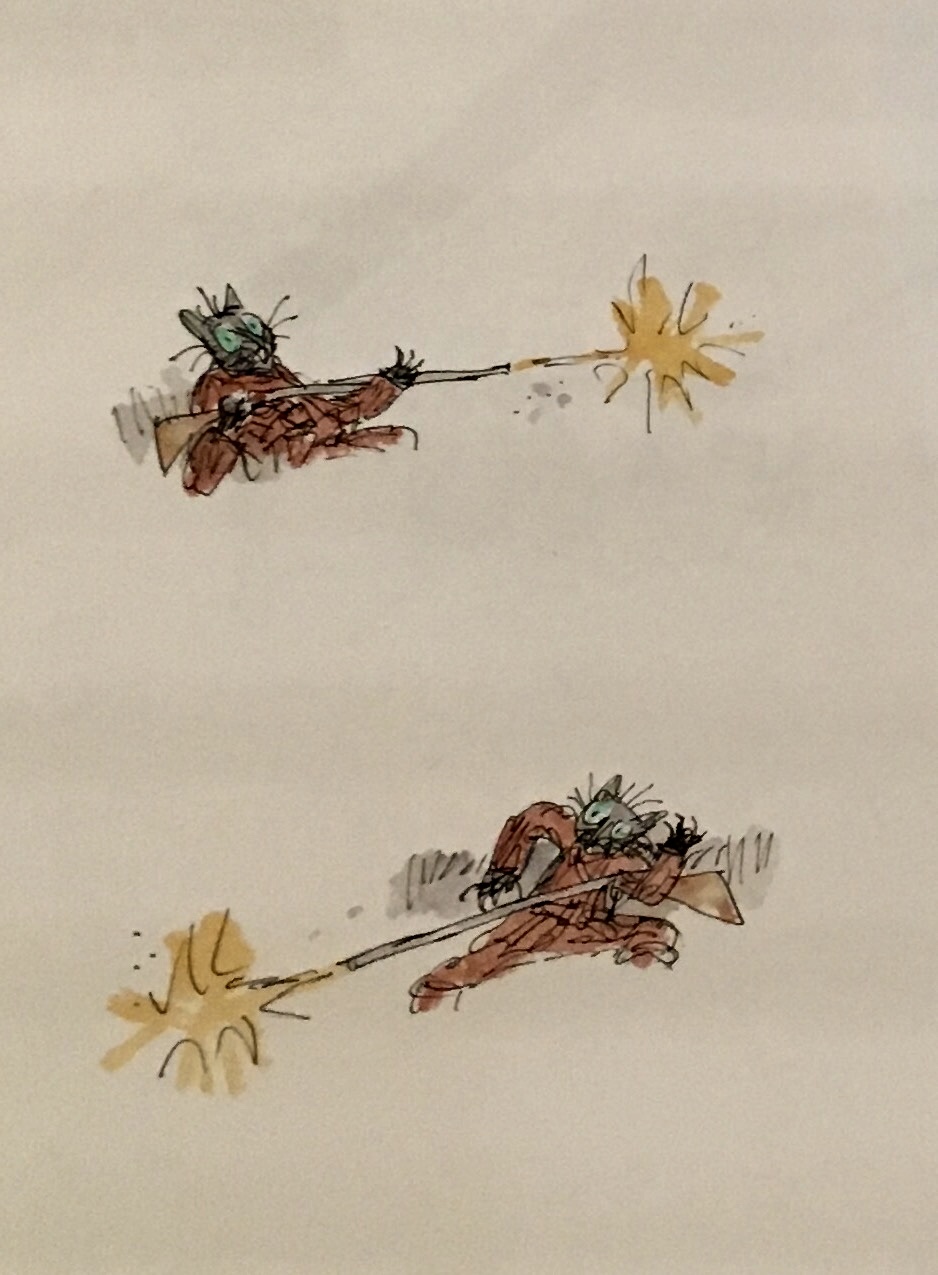
Quentin Blake's work on Kitty-in-Boots on display at the House of Illustration

Quentin Blake’s work on Kitty-in-Boots on display at the House of Illustration

The second exhibition, of his work for The Tale of Kitty-in-Boots, opens with a table containing Blake’s materials, and a work in various stages of progress (which as an artist is an engrossing installation to see). The first part of the exhibition also includes the single drawing Beatrix Potter did for the frontispiece of the book, and a page from her manuscript, which was discovered in the V&A in 2014. This exhibition shows off a substantial collection of original artworks by Blake for the book, and certainly sated my curiosity about what materials he uses, and what sizes he works in.

This dual exhibition is a wonderful insight into how he works. Blake works to scale – creating the illustrations at roughly the same size as they appear in print – and works in pen, of the sort involving nibs and pots of ink, which explains the rough mark-making he sometimes employs in depicting characters.

I started out believing Blake had a talent for being lucky in throwing together random lines which just ‘work’. Some lines are haphazard, some clear and certain, some lose their ink halfway and become fainter lines, which then adds to the richness and subtleties of his characters. But soon I realised that these lines that appear careless and random are in fact very deliberate, despite their whimsical, free-flowing appearance. His lines are anything but careless and unconsidered; they embody movement and describe the character personality and physique. Not one of them is misplaced.

Quentin Blake's work on Kitty-in-Boots on display at the House of Illustration

Quentin Blake’s work on Kitty-in-Boots on display at the House of Illustration

He draws first, then adds washes of colour. I was startled to discover the colour is applied with as much care and deliberate, decisive action as the lines. It takes a lot of practice to make splotches of colour look both unplanned and yet perfect for the artwork: it is something I grapple with fairly often, as I venture into watercolours. Too much consideration and planning can lead to a tired and over-worked surface, as you kill the spirit of the piece with too much attention.

It takes great skill to make illustrations look so easy. That is the sign of a consummate artist, in my view. So, if you’re up for seeing some work by one of the great living artists of our time, head on over to The House of Illustration, before the exhibitions end!


The BFG in Pictures is on display until 2 October 2016. The Tale of Kitty-in-Boots is exhibited until 5 February 2017. http://www.houseofillustration.org.uk/whats-on 

Review: “Digest” by Tisna

London-based Dutch artist Tisna Westerhof is exhibiting works at the Dutch Centre, at Austin Friars in the City of London, as part of her exhibition entitled “Digest”.

IMG_0002

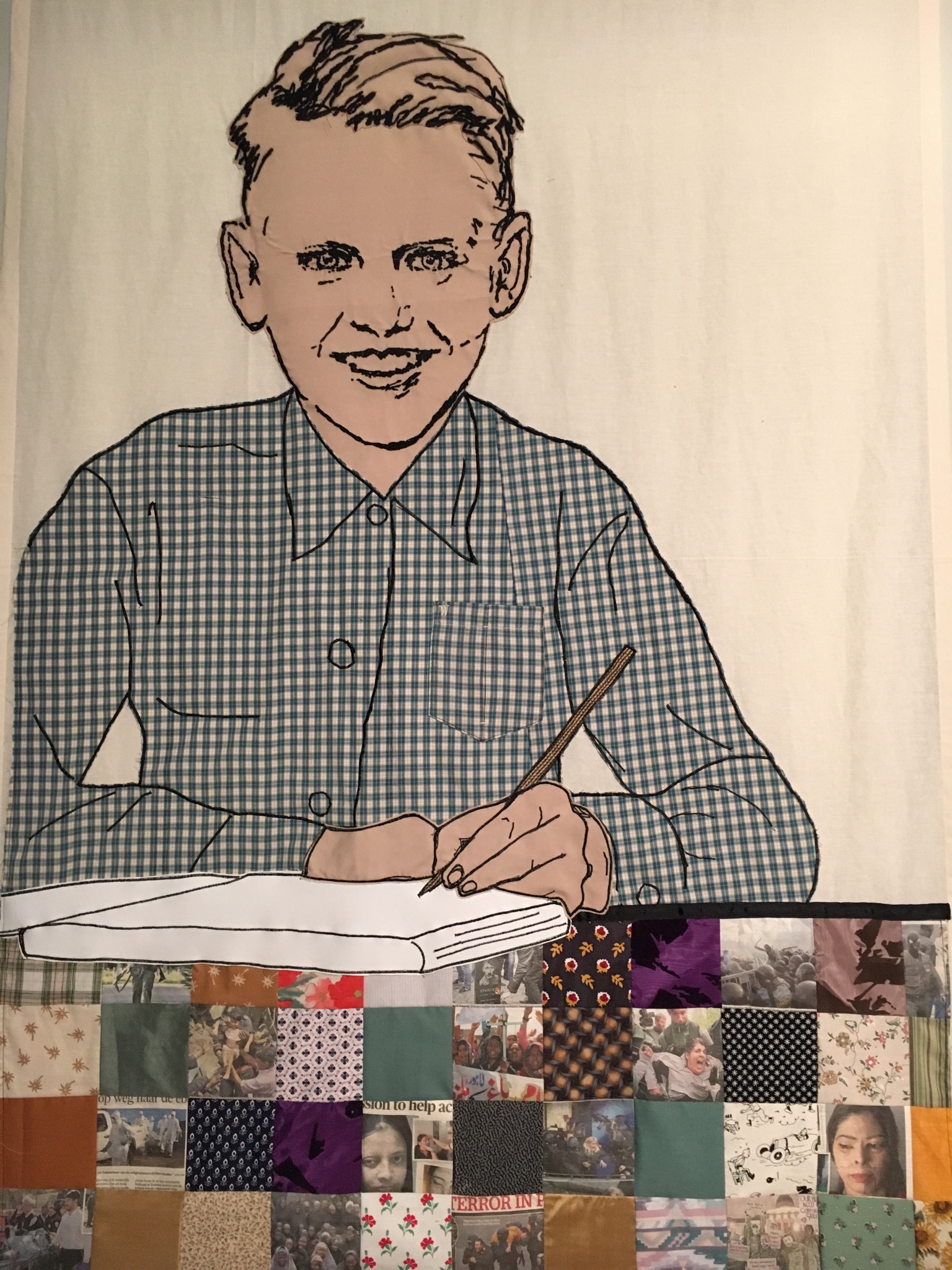
From ‘Costume Drama’ by Tisna Westerhof.

This cleverly-titled exhibition – playing on the word’s double meaning, relating to food and digestion, and also to a compilation of material – brings together large embroidered portraits from her ‘Costume Drama‘ series; screen prints of Delft Blue vases from ‘Vessels‘; ceramic tiles from her ‘Delft Blue‘ collection; and works from the original ‘Digest‘ series: paper plates decorated with images from newspaper reports in Delftware style.

“Digest” is a clever reference not only to the eclectic nature of this collection and of course to the Delft Blue plates and vessels that are carriers of food and drink about to be digested, but also a strong nod to the compilation of news stories from the last 24 months, evident in the works. These include news events and their associated slogans, such as the Black Lives Matter movement, the loss of Flight MH17, Free Our Girls, the Ebola Virus epidemic, Je Suis Charlie and the war in Syria.

IMG_0004

Works from ‘Delft Blue’ by Tisna Westerhof.

The gravitas of the ceramic tiles in ‘Delft Blue‘ is felt thanks to the fact the medium harks back to centuries of Dutch cultural tradition, but jars with the somewhat banal subject matter: modern cityscapes interspersed with larger-than-life child figures, playing in the Thames, hanging off buildings, swimming in floodwaters. The manner of the representations – detailed cities, almost photographic in depiction, against the simply-drawn children – only adds to this dissonance.


These conjoined subject matters are absurd together, but the nonsensical juxtapositioning left me wondering: what would children – these giant children in the paintings – make of our odd, modern lives?

Perhaps the addition of the children in these painted tiles helps create even more mental distance between the viewer and the cityscapes, and this distance helpfully lets us consider the ceramics as perhaps a modern representation of life, through Delft, rather than pretty decoration.

IMG_0007

From ‘Digest’ by Tisna Westerhof.

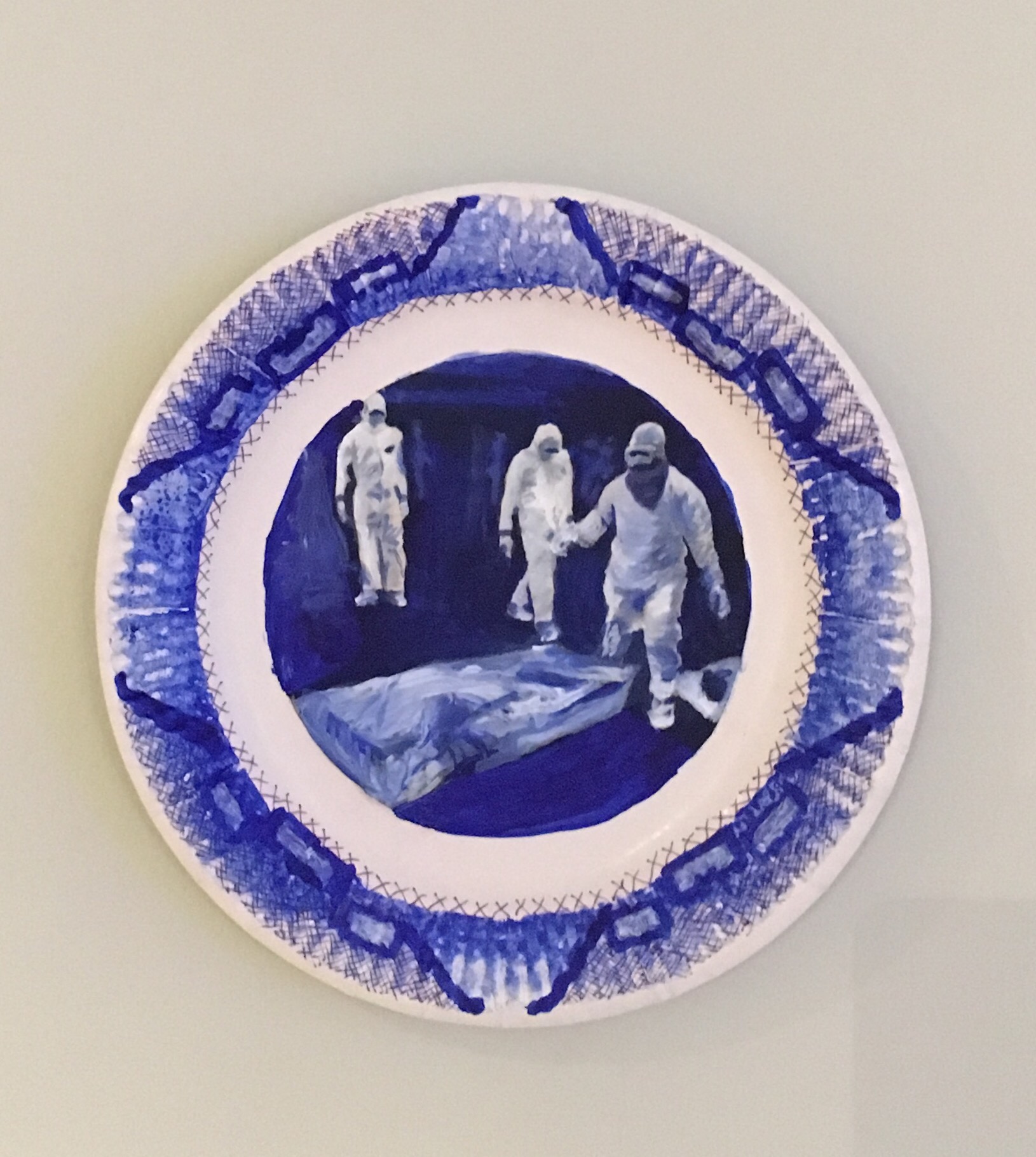
The plates painted in the Delft Blue style were a particular favourite of mine. While the plates were sadly only made of paper, I did find that the blue paint does indeed help mimic the old ceramic panting style. Plus, the disposable nature of the plates is perhaps preferred to ceramic, as it helps to highlight the throwaway nature of modern life.


Again, the absurdity and banality of juxtapositioning the “ornamental” identity of painted plates with some fairly sobering topics, produces dissonance and gives the viewer pause.

A painting of the Nigerian schoolgirls captured by Boko Haram is encircled by decorative flowers; crowds waving ‘Je Suis Charlie’ signs are framed by lace and more blooms; body bags filled with victims of Ebola, and medical

IMG_0009

From ‘Digest’ by Tisna Westerhof. 

workers in protective bodysuits, are surrounded by a pretty pattern.
Part comment on our collective desensitisation to the horrors in the news, part sociological record of our times, these plates are so original, if not in subject matter, then certainly in execution and format.


I thoroughly enjoyed puzzling over these works; hopefully you will too.

For full details of the works on display, please visit Tisna’s website at www.tisna.com.

IMG_0012

From ‘Digest’ by Tisna Westerhof.


Review: Royal Academy Summer Exhibition 2016

In a surprise twist of plans, I ended up going to the final day of the Royal Academy Summer Exhibition today. (I was meant to be going on a blind date, who cancelled on me with 30 minutes to go; so I took matters into my own hands and took myself on a date to the RA!)

There is something electric in the brave eclecticism of the Summer Exhibition, that has made it a staple of the annual London cultural diet. It’s not often you see works by esteemed, well-known artists alongside those of emerging artists, on quite such a scale. Over 1,200 pieces are on display, in media ranging from pencil and pen, to acrylic and watercolour, and from sculpture and architecture to video, and everything else in-between.

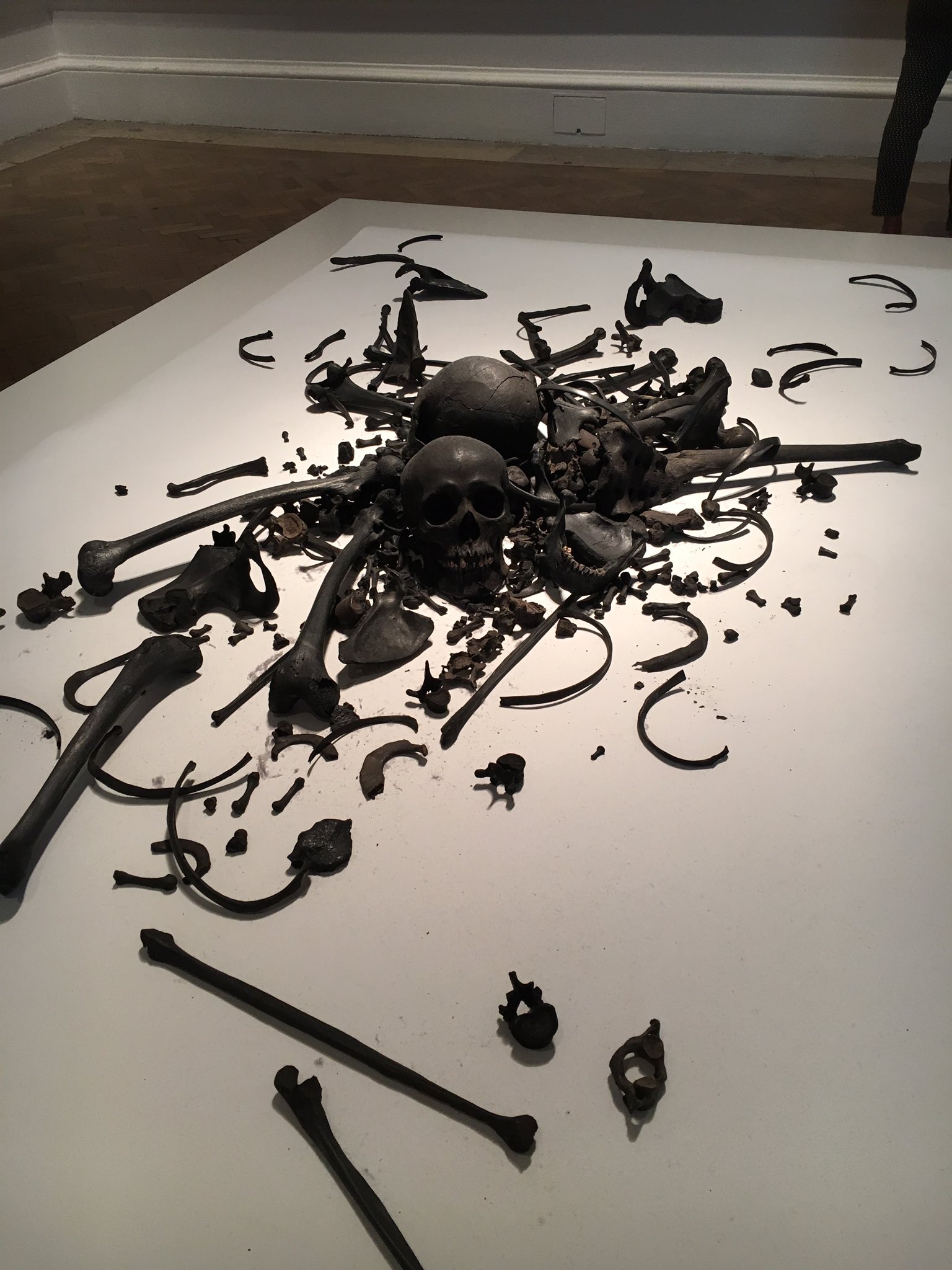
SELF PORTRAIT AS CHARCOAL ON PAPER by Zatorski + Zatorski

SELF PORTRAIT AS CHARCOAL ON PAPER by Zatorski + Zatorski

A notable feature this year is the prevalence of artistic duos exhibiting work, specially invited by the exhibition co-ordinator, Richard Wilson RA.  One of my favourites of these double acts was “Self Portrait as Charcoal on Paper” by Zatorski + Zatorski.

This eerie piece, rather morbid at first, manages to be quite cool in how it has taken a literal interpretation of the concept of a self-portrait: an artwork made up by elements of the self in the form of the remnants of a body. And yes, those are actual skeletons.  According to the RA Summer Exhibition catalogue, the piece is made of “carbonised male and female human skeletons, drawing paper and gold” (the gold bits being false teeth). So it really is an artwork done in charcoal, but not the way we’re used to. This piece is jarring and thought-provoking around the concept not only of art and self-portraits, but in terms of self and whether we remain “ourselves” once we’ve died, and once our bodies start changing after death.

As with many exhibitions, I found there was just so much to take in at the Summer Exhibition. (What doesn’t help, I think, is the hanging of some works so high up you either miss them entirely or it becomes quite a challenge to take them in. I know, I know, they’re in the catalogue, but nothing beats seeing it “in the flesh”, at a distance and at an angle that allows you to fully experience the work.) I don’t want to call for smaller exhibitions necessarily, but I must admit to struggling to taking it all in, and at times (at this exhibition and others) I do find myself wondering whether there is more to be gained from smaller, concentrated exhibitions that allow you to get more involved with fewer pieces. 


Not your average coach

Joanne Pohl speaks to life coach Lucy Addison about her blended style of coaching, how she left a high-flying career in finance to pursue her passion, and finding meaning in what she does.
Lucy Addison Coach by Joanne Pohl

© Joanne Pohl

“This can’t be all there is to life”

That was the thought that had confronted Lucy Addison as she contemplated her outwardly-perfect life, and considered making some major changes.

“I had had a good education, loving, generous parents, a car, a house, a partner, and a successful career. And yet, I was miserable and struggling”.

Now a life coach, Lucy helps her clients attain the goals they want to reach in their lives. The former unhappiness she experienced seems to have melted away.

A life coach is not a psychotherapist, psychiatrist or a medical doctor, but someone who helps clients work towards reaching their goals. According to the international Association for Coaching, life coaching is a process in which the coach “facilitates the enhancement of work performance, life experience, self-directed learning and personal growth of the coachee”. The methods employed are “collaborative, solution-focused, results-orientated and systematic”.

Lucy’s definition of a life coach is a lot more holistic than the classic definitions put forward by official life coaching bodies, and she is aware of the sensitivity surrounding definitions. She describes herself as a life coach and consultant, with the latter title giving her a more liberal space within which to operate.

She sits across from me in her living room, as she tells me animatedly how she got to this point after a career in a totally different field, and how she developed her own unique style of life coaching and consultancy.

Born in Hong Kong to British parents, she attended boarding school and university in the UK, and later worked in China and the UAE. Lucy was 6 years old when her mother became terminally ill with cancer: apart from chemotherapy and other western treatments, her mother also used Chinese medicine, acupuncture, reflexology, aromatherapy, meditation, prayer, nutrition, massage and a feng shui master.

“That was the world I grew up in: one of many elements, blended,” she says.

This international upbringing, with parents who embraced the cultures they lived alongside, and living as an outsider in different cultures, has helped in her coaching work, making her sensitive to difference.

“I’m not a perfect human being, but I try to be as aware as possible, that there is more than one way of doing things.”

An alumnus of Leeds University, where she studied History and Theology with Religious Studies, she was raised as a Christian, but later eschewed that religion to a large extent and adopted an holistic approach to spirituality.

For Lucy, spirituality does not necessarily go hand-in-hand with religion or religious bodies.

“In coaching, there is a seeking involved; the client is seeking to bring about change, and that is  essentially spiritual,” she explains.

Her role is a blend of personal development coach, spiritual journey-facilitator, energy healer, Emotional Freedom Therapy (EFT) practitioner and angelic reiki master.

Her approach is not one-size-fits-all in nature, and says she is able to do more classic, “pure” coaching, without the spiritual elements, dependent on her clients’ preferences.

“But if a client wants more, and wants to get more benefit from the coaching, I find the sense of being part of something bigger than just ourselves, and that we matter to the bigger picture, helps,” she says.

Apart from the traditional life coaching methodologies, Lucy also uses prayer and meditation – usually more associated with organised religion, but which to Lucy are more generalised spiritual tools – to aid the process, if the client is amenable to these processes.

“I’d suggest that when seeking is paired with prayer and meditation, there’s a faster change for the better. I think this is because there is a sense of security and groundedness that these things bring,” she says.

Aside from training in Personal Performance Coaching through the Coaching Academy, Lucy is also trained in Angelic Reiki, is an Angelic certified practitioner, and also teaches Mindfulness. Currently she is training in hypnotherapy. This gamut of experience is a big advantage, as increasingly, her clients want an holistic approach to what ails them. Lucy views the being as an ecosystem, not broken into discrete parts, and this holisticism is therefore very important to her.

“There is a grief tangible in people, that seems to make itself known when we’re not taken as the 3-dimensional beings we are. It causes stress when not all of us is taken into account by our lives and jobs.”

Lucy has first-hand experience of a corporate world that seemed to disregard the human beings that were its constituent parts, in pursuit of profits.

After graduating from university she joined a major international bank’s graduate recruitment scheme, in their corporate affairs department. Rotations within the company saw her operate at group level in London, at country level while based in China, and at both a country and regional level in the UAE. Being amongst other cultures was a highlight for her, but over time she found that the life she had pursued did not suit her. She had low energy, was ill fairly often, and saw people around her struggling too.

“I found myself wondering whether this was all there was to my life, and life in general. According to Maslow’s Hierarchy of Needs, I had everything I could ever need, and yet I was still miserable, and I and the people around me were struggling,” she explains.

When the 2008 financial crisis hit the Middle East, where she was based, she witnessed a lot of fear, insecurities, troubles, and very little meaning to show for it.

“I found myself wondering where the humanity was. We are not machines. Human beings feel, they are creative, inquisitive, valuable and precious. Life is precious.”

Lucy Addison Corporate by Joanne Pohl.jpg

© Joanne Pohl

Instead, she observed a lot more behaviour of treating humans like machines at that time. “People – men and women – disowned parts of themselves and their personalities in order to fit into the system, and I found this painful and disturbing,” she says.

“I refused to believe that this is all there is to life – that we are conditioned to set our sights on a career or role, accepted by society as valuable,” she says, firmness in her voice.  She found that she needed to pursue a life that rang true to her values, and that is what she did.

Her journey from banking to her current career wasn’t a smooth transition, and took some exploration as she carved out a niche for herself.

“I wasn’t even aware of that I could have this kind of career, because what I’m doing now is quite unique in my world,” she says.

“I think a lot of people don’t understand what life coaching, or coaching in general is, but it’s getting better,” Lucy tells me. When she tells people she is a coach, they often assume of the sports variety.

“Society is very familiar with sports coaching, but life and personal development coaching is seen as a bit of a lofty term, and something that verges on the ‘woowoo’, and often veered away from,” she says.

Interestingly, she says, the corporate world have started adopting coaching more, to their benefit, but using it in a purely corporate context, for example to help management get the best out of a team.

One of the biggest benefits of her new career direction is the abundance of meaning in what she does. “As a coach, the meaning you help create, and the meaning that I have, is more long-lasting. In the corporate world, I could attach my own meaning to a project I’m working on, but it could get canned, and for very sound business reasons too. But it hurts, to lose that project, when you’ve invested so much in it, especially without being taken along in the decision making process to can it. When this occurs regularly it is challenging to create motivation and meaning in your objectives. Trust evaporates.”

I ask her whether – despite the uniqueness in each human being – there are any recurring themes or common problems that her clients face. She nods and says that almost everyone she encounters is hard on themselves, and everyone is seeking validation that they’re OK.

“We are often far harder on ourselves than we perceive the outside world to be viewing us. We make up a lot of stories about what others think about us and that often leads to us losing out on the fullness of ourselves and opportunities that come our way,” she says, adding that there’s a lot of room to be kinder, more gentle on ourselves.

I ask her what her goals for the future are, and she smiles as she tells me that in the short term, she’s looking forward to going sailing again. Her husband is a keen sailor and she’s in the process of learning. “Sailing has the potential to put you in touch with something bigger than yourself, and you feel really small out there!”

Longer term, Lucy aims to do what she can to make a bigger difference in the world.

“I want to join in, in making the world a better place, and do so by getting better at what I do. I would love to see humanity backing things where we get to be whole in whatever we are doing, and are not required to disown parts of ourselves.”
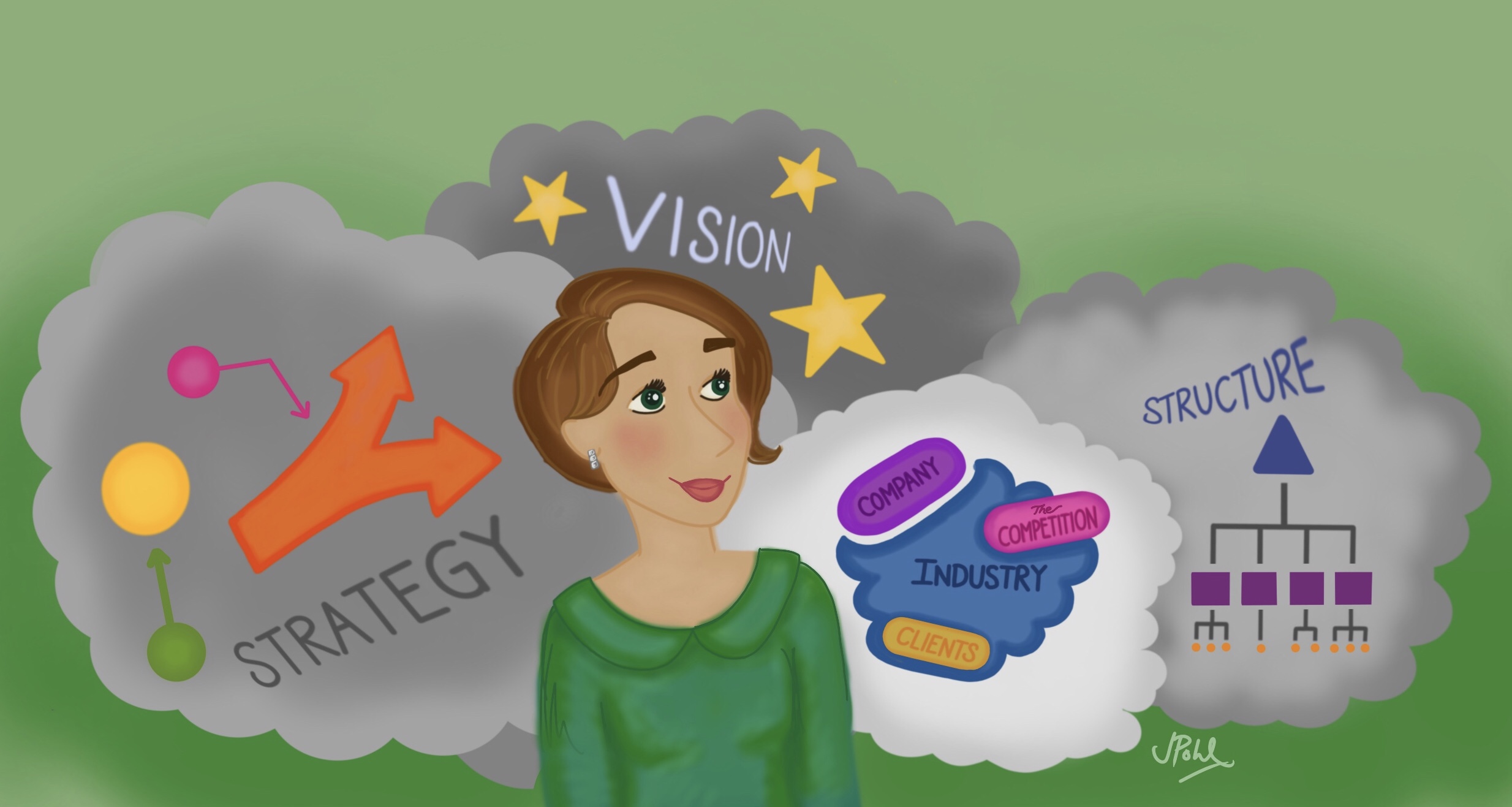
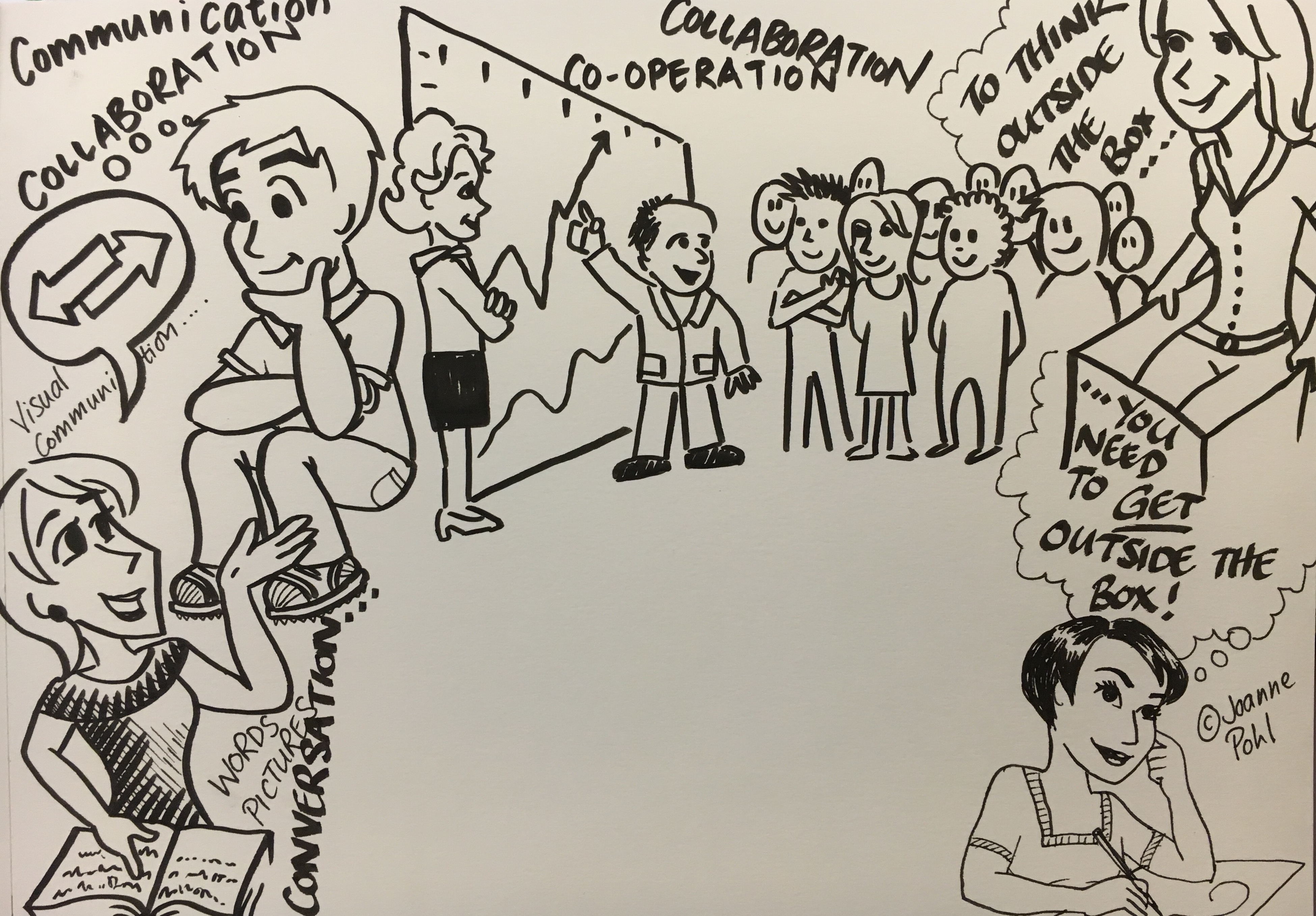
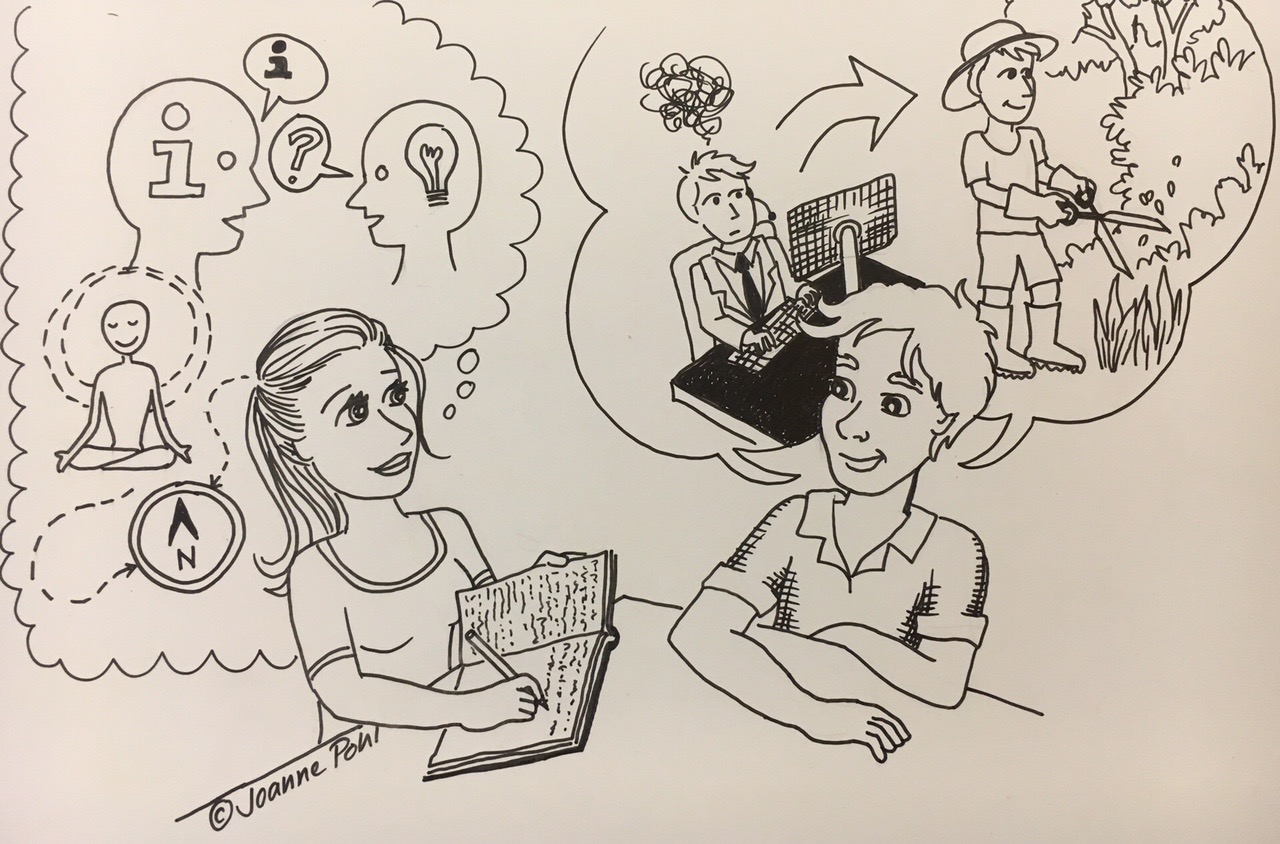
Visual & textual communication

This article is fascinating:

“Retailers and brands are already aware that visual content is a valuable tool and sharing it is important for their brand awareness […] visual content reaches an individual’s brain in a faster and more understandable way than textual information. Or, more accurately, a person’s brain is hardwired to recognize and make sense of visual information more efficiently”.

Joanne Pohl illustration

© Joanne Pohl

Visual Communications

© Joanne Pohl

Review: Monty Python Live (Mostly)

Ok, Monty Python is not everyone’s cup of tea. I’ll admit it wasn’t mine at first either, but then again I was only properly introduced to it in 2007 when a new friend who had the DVD of And Now for Something Completely Different sat me down to introduce me to the monolith (I am told that this work by the Python chaps was possibly not the best way to get to know them: I found the film rather disturbing, much like a surreal nightmare).

I didn’t grow up in the UK, and missed out on a lot of global culture while growing up in the ignorant idyll that was the family farm. When I went to high school, I heard peers refer to Monty Python, and I must admit that, having no idea what they were talking about, assumed it was a funny sitcom about a snake.

When my other half bought us tickets to see Monty Python: Live (Mostly) I wasn’t overly keen, but game nonetheless for a new cultural experience. Having still only seen And Now for Something Completely Different (I was too put off to watch any other Python films) I approached the evening with as much objectivity as I could muster. 

What I wondered about the most was how Python was going to transition their performances from the media of TV and film (screen) to stage, and how well this would work for their sketches. 

The show is mostly a re-performance of old favourites (à la the deceased parrot sketch, the Lumberjack Song, the Albatross, Every Sperm is Sacred, et al) with the performers older but still as funny and even more popular, and with some elements updated (contemporary cultural references, cameos by personalities such as Prof Brian Cox and Stephen Fry). It has received mixed reviews, and I can understand why: it is more an act of worship of the Monty Python glory days, and pays homage to this cult classic, the various characters in its sketches, and the actors themselves. A couple of times on the evening we went, John Cleese slipped out of character – something which is a complete no-no in traditional stage theatre – and this received exuberant applause from the audience.

The show struck me as a tribute act with a difference: it was performed by most of the original stars, and was not adventurous in terms of new material. It was not high-brow, but was a fun evening out, and was a bit like attending a live museum, displaying the highlights of an iconic part of the history of British comedy.